
AI Is Accelerating Engineering, But Physics Remains the Source of Truth
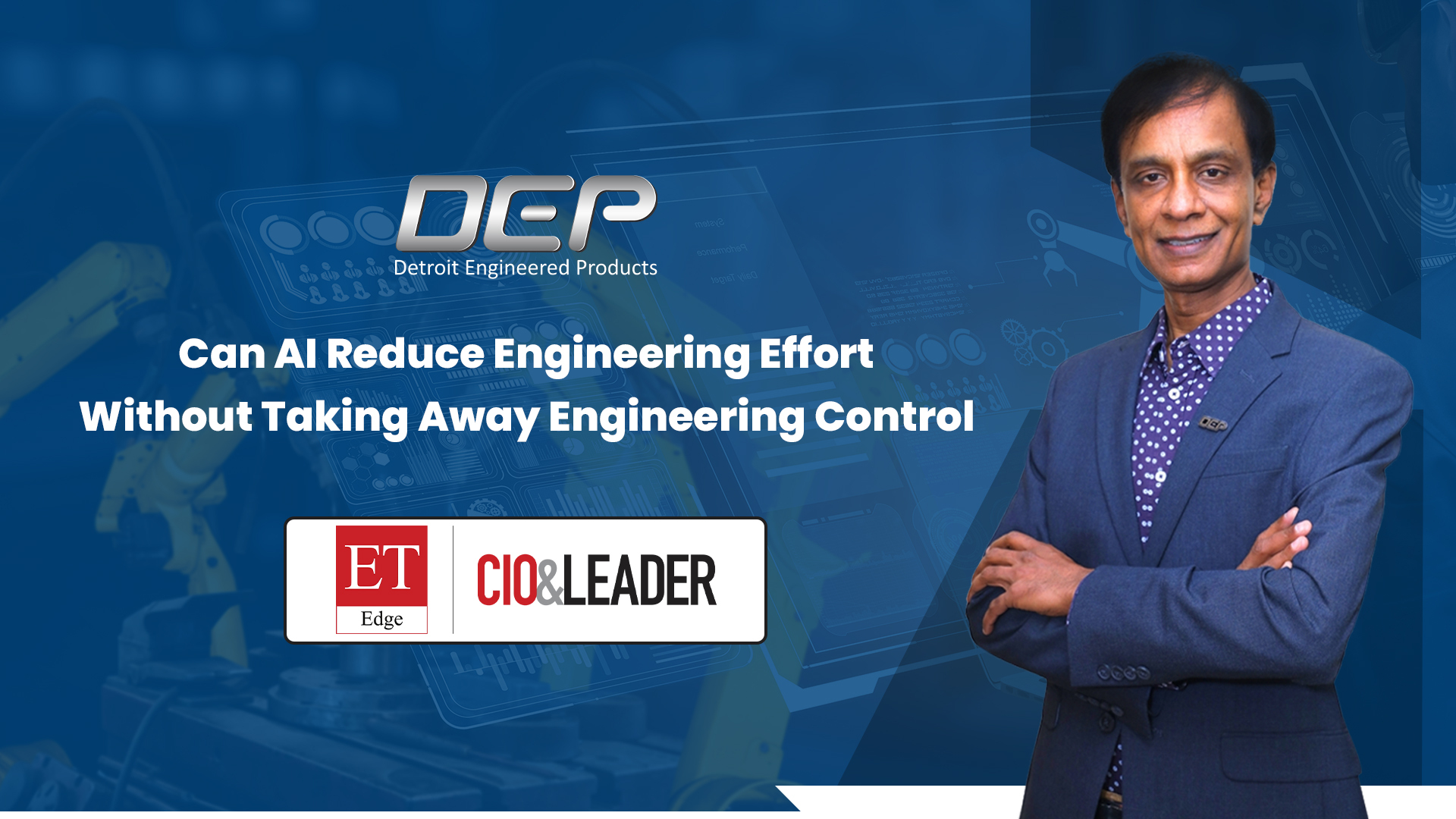
Mr. Radha Krishnan, Founder and President of Detroit Engineered Products (DEP), shared his perspective with CIO & Leader in an exclusive Q&A. In his responses, he discussed how AI is changing the way products are designed, simulated and validated, and India's growing role as a hub for deep-tech product development.
When DEP set up its Chennai operation in 2000, India was still seen mainly as a place to execute work. He noted that this has changed significantly. Today, engineers in India define algorithms, build products and solve complex engineering problems for global customers. DEP's entire software development team is based in India, and Chennai has been central to the company's software journey for more than two decades. He explained that CAD and CAE are not going away, but their role is changing. Engineers have long moved data through a chain of separate tools for design, meshing, simulation and optimisation, and AI is starting to bring these steps closer together. As he put it, "The real question is whether AI can reduce engineering effort without taking away engineering control."
With DEP AIWorks and the AI-powered MeshWorks platform, AI is not asked to replace physics. Established solvers remain the source of physical truth. Machine learning learns from simulation data to build surrogate models, predict outcomes and explore far more design options. He also noted that generative design needs clear boundaries. DEP keeps loads, material properties, boundary conditions and manufacturing requirements in the loop, so that AI searches faster but always within the limits of real-world engineering.
Digital twins can significantly reduce physical testing, but he does not expect them to eliminate it, especially for automotive safety compliance. The real benefit is making every physical test count. Engineers can screen hundreds of options virtually and validate only the most promising designs. In fast-moving sectors such as drones, aerospace and advanced air mobility, automating geometry preparation, meshing and simulation setup helps shorten the design loop. Engineers can then spend more time making decisions and less time waiting on models. He also pointed out that the savings go beyond software licences, since engineering hours are usually the larger cost. Bringing design, meshing, simulation and post-processing into one workflow lets teams evaluate more alternatives with the same effort. They can make key decisions earlier, while changes are still inexpensive.
Looking ahead, DEP will continue to invest in engineering software while staying close to real customer problems. Chennai remains a key R&D centre as the company expands its global presence. DEP is also growing beyond its automotive and CAE roots into aerospace, advanced mobility, manufacturing and other engineering-intensive industries.
Read the full Q&A in CIO&Leader: https://www.cioandleader.com/the-real-question-is-whether-ai-can-reduce-engineering-effort-without-taking-away-engineering-control/